Here are 8 Tips to make sure your spearguns are always accurate.
When talking about speargun accuracy and shooting straight, you need to first start with your speargun.
Is the gun you are using shooting straight?
Now you hear it all the time that this brand is more accurate than that brand. When I hear this I just switch off because this is complete BS and you can make almost any speargun shoot straight with the right setup.
That is unless the gun is completely dysfunctional and badly designed.
Also make sure you are using the correct gun for the job. Big guns are more difficult to maneuver and will limit your ability to take advantage of the best shots. Leaving you taking flyer shots on opertunities that should have been easy. Likewise a gun with insufficient power and range will leave you frustrated and will only dent your confidence. I do cover a fair bit of this in the previous videos.
If you have a rollergun and are not sure how to set it up I suggest watching this series on Unrolling the roller from the beginning. You will see a link in the top right hand corner.
With that said lets climb right in, here are my 8 Tips to ensure your spearguns are shooting accurately.
No1 - Straight Shafts
You can have everything else right, but if your shaft is bent you are stuffed. If you are battling with accuracy this is the very first thing to check.
Checking your shaft is straight is really simple. The best way is to roll your shaft. You can look down the shaft to see if it is bent. It is difficult to see subtle deflections this way, but if the shaft looks bent just by looking at then you know it is 100% bent and no good.
Rolling the shaft is by far the best and super easy. Take two parallel and level surfaces. The back rests of two chairs works well, but so will two spearguns on a table or any flat surface will also work just fine.
Take some tape and tape up the barb or remove the sliptip.
It is best not to have any shooting line attached, but if you testing a shaft you are using and dont want to cut the line. Use the line to roll the shaft like this.
If the tip wobbles the shaft is bent. You can also hear if the shaft is bent, and it should have smooth even sound. If the shaft is really bent you will see that the shaft will want to stop and always come to rest in the same place. Even a slight wobble will affect your shot.
If an off centered tri-cut affects your shot how much more will a bent shaft?
In this situation it is best to replace the shaft with a new one. But check the new shaft before you put it on the gun. Even better, you check the shaft in the shop before you buy it. Knowing 100% you shaft is straight is 90% of your aiming confidence right there.
No2 - Correct Shaft
Now that you have ensured you are not using a bent shaft, make sure you have the right shaft for the set up you are using.
Make sure the shaft and rubber combination you are using is correct. Often guys use shafts that are too long and thin on rollerguns and this will cause the shaft to whip. This is essentially over powering the shaft and the longer and more flexible the shaft is the easier it flex when coming out the muzzle. This not only causes inaccuracy but the shaft wobble causes drag and slows the shaft down.
The general rule with shafts on rollerguns is the shorter the better.
Again check out the videos on the different setups as a reference.
No3 - Tune your barb
If your shaft is straight and the correct length & diameter. The next thing to check is your barbs. This is alot easier to check in a pool shooting at a target.
Your barbs will affect the height of your shot. The end tip of your barb when flared out will create lift, and will either lift or drop the shaft depending which side of the shaft the barb is on.
Single barb shafts are most common on the underside of the shaft so if you need to raise your shot you can do so by flaring out the barb.
You only need to flare it out by a few millimeters to lift the shaft by a 5-10cm at range. Likewise if you are shooting too high. Then flattening the barb will drop the shot down.
Many guys battle with double barbs as the top added barb creates drag on top of the shaft making it shoot low.
If this is the case a small flare on the underside of the shaft will lift the shot.
A handy tip is to cut a groove in you dive knife for tweaking your barb. Take a hack saw and cut 3-4mm into a thick strong part of the knife. This way if you are finding your shots are off in the water you can easily adjust your barb right there and then.
I have found this to be invaluable.
No4 - Correct band setup
Now with rollerguns your band setup will not affect your accuracy as much as a conventional gun, they are quiet forgiving. This is mostly because there is very little recoil to deal with.
That said if you have the wrong band setup you will also run into accuracy issues, rollergun or not.
When the guys rollerguns are underpowered they generally don't have accuracy issues other than the shaft dropping at range. But as you start increasing the power you put into the shaft. Then any underlying issues like a slight bend or a shaft that is too long and whippy. You will start to see the accuracy start to become more of an issue.
The greatest issue is normally with the guys trying to get the most out of their guns. In these cases matching your shaft and making sure it is straight as we have just covered is a good place to start.
But like I have covered in other videos the magic of rollers is not just the accuracy but the way it shoots.
The way the gun shoots, if it is smooth with low or no recoil, this will help you with your accuracy. What I mean by this is that if you are flinching or having to anticipate the recoil this is going to affect the way you shoot.
If you need more power and range always opt for a longer gun if you can. Rather than trying to get your 110 or 90 to perform like a bluewater gun.
When it comes to pretension and accuracy. Because of recoil affecting accuracy, full pretensioning your rubbers is the only way to go. I cover this extensively in the second video of the series.
One of the most asked questions I get is micro bore rubbers and the difference between ‘Reactive’ & ‘Progressive’ rubbers and what is best.
Micro bore rubber in my opinion only makes inserting wishbones difficult and adds little to no value whats so ever. It is not like it magically adds any extra power. The strength of your rubber is directly related to the volume of rubber. Micro bore adds a small amount of volume to the rubber, but in most cases the guys then go down in outer diameter.
Work out the area of the cross section of rubber. Subtract the internal bore. Compare that between standard bore and micro bore and the difference is nowhere near as substantial as changing the outer diameter. Rubber with a 2.4mm ID is fine.
You land up cutting the rubbers to what is comfortable to load anyway so just stick to the std bore rubber.
Then you have the guys that are about Reactive’ & ‘Progressive’ rubbers.
My opinion this is just marketing babel. I think the correct term would be high or low modulus rubber, just does not sound as cool. Harder or high modulus rubber can give you more power, but at the expense of recoil. Softer low modulus rubber does not give you as much power, but will provide a smooth accurate shot. Generally the stiffer the rubber is the longer you have to cut the rubbers and the softer it is the shorter you have to go.
Personally I don't like high modulus or hard rubber with rollers.
That said the most important thing to look for in a rubber is low soak off over time. Spearguns are often kept loaded for hours between shots and your rubber should not lose too much load over time. Primeline Latex is probably the best in the market in this regard.
You can have everything right but your rubber setup is the one thing that is going to vary the most from person to person. If you have any doubt about your rubber setups have a look at the previous videos. Start there and tweak your rubbers accordingly. Pretty much everyone who tries the half barrel plus 5cm formula comes back with a thumbs up. So start there.
No5 - Double bridle wishbone
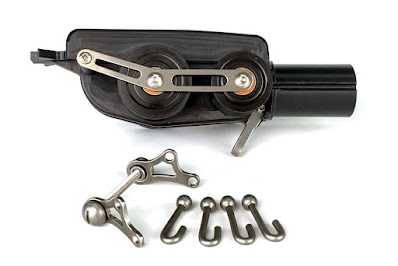
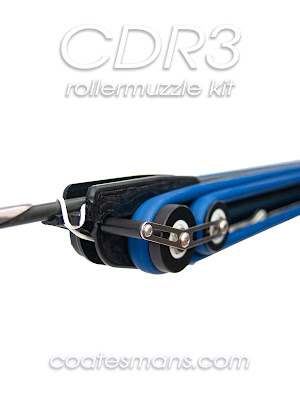
Earlier on in this video I made the comment on guys who say one brand is more accurate than another. For the most part I really do believe this. But when it comes to roller muzzles they are not all created equal.
One of the greatest issues with roller muzzles is the bridle riding up the rails of the muzzle and lifting the back of the shaft as the spear leaves the gun.
Using a double bridled wishbone you can overcome poorly designed muzzles and improve the accuracy and eliminate issues with the back of shaft lifting at the muzzle.
Check the video in the link on the right hand corner to see how to test your muzzle and rectify the problem.
So I guess you can still make a poor roller accurate after all.
No6 - Shooting line setup
With rollerguns you are generally going 10-20cm shorter on the gun over what you would have used in a conventional speargun. While this has a host of advantages, it does now reduce the length of shooting line and therefore the range with a single wrap and will also affect the guns accuracy at the end of this range.
What happens as the shaft comes to the end of the shooting line, and the slack in the shooting line is taken up it causes the back of the shaft to deflect. This causes the shaft to ‘shotgun’ right at the end of the range.
With short rollerguns this is frustrating because single wrap range is where the gun is still very effective. This means that you have to go double wrap. This double wrap now allows the shaft to hit its target at full single wrap range without being affected by the shooting line taking up the slack behind it.
You can test this yourself by setting up a target at full single wrap range, and taking a few shots. Then moving the target back one shaft length so that the shaft penetrates almost all the way through the target and compare the accuracy.
So when guys ask me why I always use double wrap it is not because I want to shoot double wrap distance. Its because I want to be accurate at a practical range around single wrap distance.
There is a down side to double wraps tho, specifically when hunting on the reef. You are now giving the fish those extra few meters of shooting line to run and reef up. So you do need to be conscious to quickly take up the slack shooting line as quick as possible to reduce the risk of getting reefed up.
No7 - Keep all your guns the same
Keeping all your guns the same will reduce the need to adjust from one length gun to another.
Keep all your grips the same. This will ensure the angle of the grip is not changing, this is very important, especially if you use the point and shoot technique for aiming.
The trigger pull also needs to be consistent regardless of the load on the mechanism. So everytime you pull the trigger regardless of the length or power of the gun, it must be the same.
So for this keep all your grips and mechanisms the same.
Likewise keep the muzzle ends of the gun the same or as close as possible. So when you look down the gun the vision you have is the same.
This also goes for the overhang of the shaft. If the over hang on your different guns vary too much you will have a hard time adjusting from one gun to another. Especially if you aim off the tip of your shaft.
Keeping everything uniform will ensure that you will be able to flip flop between guns, even on the same day without having to adjust or messing with your confidence.
No8 - Remove all doubt
One of the most important and often not spoken about factors in shooting straight is your confidence. You can have everything dialed in, a great accurate gun in your hand, and if your confidence is low. You will land up second guessing yourself in a situation where the pressure is on. You need to be 100% confident in your gear and your self to make good decisions and take advantage of the best opportunities that come your way.
This is why pool testing new guns is so important. Getting the gun dialed in and building confidence is the most important thing you can do with a new gun. Better yet, as in the previous point. Keep all your guns the same. This way there is almost no need to go through the learning curve of a completely different gun.
This is actually one of the primary reasons I developed the CDR double rollergun. I have so many clients that are huge Rob Allen fans. But every time we went on a dive trip where they wanted something with a little more vooma than what a std RA could deliver and so got big bluewater guns.
Almost all the guys battled to adjust to their new bluewater guns with confidence, especially because they were not guns they used on a regular basis. No matter how good they were.
Now with the CDR they have the same grip, trigger pull and similar view down the barrel so transitioning to a bigger gun is very simple and seamless.
Confidence is everything, if you have been spearfishing for any length of time you will know what it is like when everything is going right and you just can't miss. But you will also know how frustrating it is when you can't seem to hit anything.
In many cases when you start to miss fish on a day its because of a bent shaft or dodgy barb. And if you dont pick up that its your shaft, you will destroy your confidence as you will continue to mess up valuable opportunities.
The best solution to this is to have a complete gun that is 100% perfect to swap out to. Or at very least an extra straight shaft on the boat.
I try as much as possible to always have 2 of the same or similar gun that I can swap out on any dive. Be it a boat or shore dive. This way if I take a shot and miss, and know it was not because I took a flier. Or if I even slightly suspect there is an issue with the shaft, especially if I have just shot a fish. I swap out to the good gun and never second guess myself.
Here is one last Bonus Tip.
Adapting to Rollerguns
When specifically talking about rollerguns and transitioning from old school conventional guns. Some guys battle to make the adjustment.
I think it is primarily for these two reasons:
No1 - they have one foot in the roller side and leave the other back with their std guns. Rollers and conventional guns shoot completely differently. Conventional guns kind of lob the shaft, with recoil, while rollers feel like they are not doing anything.
Secondly the guys start with longer rollers, they hear about the power you can magically get out a roller. Then get the biggest bad ass setup they can for their next big trip.
Almost without exception the guys who started with small rollers adapt and transition into rollers easier. I think it's for two reasons. For one small rollers really show off a rollers capabilities well. And guys are generally shooting prey that is far less consequential. So they get a bunch of no pressure shots on fish to figure it out. This builds confidence and suraty in the guns.
The guys who go straight to 120 & 130 rollers often land up targeting a ‘quality’ fish and stuff it up. Worse still its on their annual spearfishing getaway with only few opportunities. Straight away there is no confidence, and the gun lands up on the boat in lue if the tried and tested conventional set up.
Then they land up in two camps and never fully transition over, and as long as there is a little doubt. You will never be confident and get on a roll.
So my advice is if you are thinking about getting into rollers or battling with rollers. Get the shortest gun that suits your diving and go shoot a bunch of fish for the pot. Take all your conventional guns, sell, burn, or give them to a mate you dont like. Take them out of the equation completely. Force yourself to take the time to make the adjustment. As long as you keep going back to conventional guns you will have to keep on making adjustments to how you shoot and this is only causes you to second guess yourself when under pressure.
Ok so lets do a quick recap to ensure your gun is 100% accurate.
No1 - Straight Shafts
No2 - Correct Shaft
No3 - Tune your barb
No4 - Correct band setup
No5 - Double bridle wishbone
No6 - Shooting line setup
No7 - Keep all your guns the same
No8 - Remove all doubt
Bonus Tip - go all in on rollers
On a day to day basis the first and last tips are the most important. Always makes sure you shaft is straight, always have another shaft or gun ready to swap over to if you think your shaft is bent.
I hope this has been super helpful. Please drop me a comment below if you have any other tips that will help improve accuracy.
If you have not already subscribed, please hit the subscribe button and the bell to get notified when I get a new video up. In the next video I will be covering aiming techniques and tricks to never miss.