Every now and then the North Coast gives you one of those rare proper A-Grade days that reminds you why we put so much time into diving this coastline.
This trip was right in the middle of summer up on the KwaZulu-Natal North Coast, and the conditions were honestly ridiculous. Flat sea, warm blue water, and visibility that looked more like somewhere tropical than the North Coast of South Africa. If you dive here often, you’ll know how uncommon that really is. Usually there’s a bit of colour in the water, current, swell, or something making life difficult. But on this day, everything lined up perfectly.
Being the weekend, my good mates Warren and Mark joined me on my C Ski-444, the DEVILFISH. And we launched out of Salmon Bay in Ballito just after first light. From there we made the run north towards Tinley Manor, probably around 20km or so up the coast, looking for couta.
The ocean looked fishy from the start. Clean water, bait around, and good current. it just felt right. We spent a good amount of time looking for Spanish Mackerel, but despite the conditions being absolutely perfect, the couta never really arrived. That’s fishing though. Sometimes you can do everything right and still not find the fish you originally went searching for.
Luckily mother nature had other plans for us.
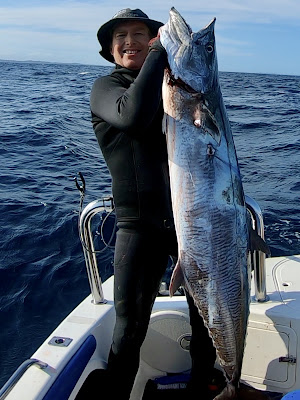
Instead of couta, we found big shoals of Queen Mackerel — Natal Snoek — moving through the area in good numbers. Once we got onto them, the action became pretty non-stop. Fish coming through clean in the blue water, good shot opportunities, and proper fun diving with mates in epic conditions. All three of us managed to get some really good fish.
For me personally, this day was also about getting some good video of my new Unicolor Camo carbon barrels.I was diving a 110 CSR3 single roller from the Unicolor Camo carbon barrel range, and honestly, the gun could not have performed better. Shot after shot went exactly where I wanted it to. The 110CSR3 is one of my favorite setups and the gun just felt completely dialed in from the start.
There’s always something satisfying about testing new gear in genuinely good conditions because you really get to see what it’s capable of. This wasn’t one of those difficult scratchy days where you’re forcing opportunities. The visibility allowed us to relax, hunt properly, pick our shots carefully, and really enjoy the diving.
And those are usually the days where you realise whether a gun setup is truly balanced or not.
This video is basically a full look into that session onboard the DEVILFISH on the North Coast. Amazing conditions, good fish, proper diving with good mates, and a chance to show the 110CSR3 doing exactly what it was designed to do.
The new Unicolor Camo range is available from 90cm all the way through to 130cm in both the CSR3 and CDR4 rollerguns.
If you’ve ever wondered what a real A-Grade North Coast dive day looks like, how a properly setup rollergun should shoot, or wanted to see the 110 CSR3 in action on pelagic fish, you’ll definitely enjoy this one.
Some days everything just comes together perfectly.
If you’ve just bought a CDR4 DEVILFISH, setting it up correctly is the key to getting the performance it was designed for.
In this guide, I walk through the full process of rigging and loading a double roller speargun — from installing the reel and routing the shooting line to tensioning the bands and loading the gun safely. Follow this setup and your CDR4 will remain clean, reliable, and ready for serious spearfishing.
Quick Guide: How to Rig and Load a Double Roller Speargun
To rig and load a double roller speargun like the CDR4 DEVILFISH, follow these steps:
Install the reel and run the reel line through the muzzle eye.
Insert the shaft and ensure the shooting line sits on top.
Attach the shooting line to the reel line using a Dyneema quick-release knot.
Route the shooting line through the muzzle guides and onto the line release.
Install the roller bands and align them along the barrel.
Pre-tension the bands in the correct sequence.
Load the rear band first onto the smaller fin, then the front band onto the larger fin.
Following the correct sequence ensures your roller speargun remains efficient, cleanly rigged, and reliable in the water.
What Comes with the CDR4 DEVILFISH
When you receive your CDR4 DEVILFISH, the core components are supplied ready to assemble.
You’ll have:
The CDR4 DEVILFISH speargun
A reel
A set of bands
A shaft
Shooting line already attached to the shaft
The setup process simply brings these components together into a clean, functional rig.
How to Install a Speargun Reel on the CDR4 DEVILFISH
The reel installation is intentionally straightforward.
The reel slides directly onto the mounting rail on the gun and locks into place with a simple forward push. Once installed, release the tension on the reel line and run the line forward through the muzzle eye.
At this stage, you should have the reel mounted securely with the line running cleanly through the front of the gun.
This forms the foundation of the entire rigging system.
How to Insert the Speargun Shaft on the CDR4 DEVILFISH
With the reel mounted, the next step is inserting the shaft.
Slide the shaft into the top handle mechanism and ensure the shooting line sits on top of the shaft. This positioning is important because it allows the line to run cleanly during the rigging process and prevents unnecessary tangling once the gun is loaded.
Once the shaft is seated properly, the next step is connecting the shooting line to the reel line.
How to Attach the Speargun Shooting Line on the CDR4 DEVILFISH
At the end of the shooting line you’ll find a Dyneema loop.
Rather than using clips, the CDR4 system uses a simple quick-release knot. This approach removes unnecessary hardware, eliminates rattle points, and creates a very strong connection that can still be undone quickly if needed.
To tie the knot:
Take the tag end of the line, leaving around 15–20cm of length.
Thread it through the Dyneema loop, and wrap it around three times.
Pull the loop through itself.
Tighten the knot firmly.
This knot is extremely reliable and can easily be tied or untied in the water. To release it, simply pull the tag end and the knot comes undone.
The simplicity of this system is intentional — strong, clean, and reliable.
How to Rig the Shooting Line on a Roller Speargun
Once the shooting line is connected to the reel line, it needs to be rigged correctly along the gun.
The line runs up through the inside of the muzzle and around the first triangle guide. From there it crosses over the top of the shaft before running underneath through the main groove between the rollers.
At this stage the line can pass on either side of the line guide. Both work equally well.
From there it runs down to the line release on the handle, back up and around the muzzle, repeated a few times.
Once the line is rigged correctly, tighten the reel slightly to remove any slack. Keeping the shooting line tight is important for maintaining a clean rig and preventing tangles.
How to Install the Bands on a Double Roller Speargun
With the shaft and line now rigged, the next step is installing the bands.
The bands simply slide into position through the CDR4 muzzle assembly. The design keeps the system compact and ensures the bands sit neatly in line with the barrel.
Once installed, the gun is ready to be pre-tensioned.
How to Pre-Tension the Bands on the CDR4 DEVILFISH
On the CDR4 DEVILFISH, the sequence is important.
Start with the top two rubbers, passing them through the middle of the lower bands. These connect to the first attachment points on the muzzle. It’s best to keep the attachment points facing upward so they remain easy to access.
When pulling the bands, it’s important to maintain some tension on both bands while attaching them. If only one is pulled, the other band can slip through the muzzle.
Once the first two bands are secured, the remaining bands attach to the top mounting points. After attaching them, flip the bands underneath so
everything sits parallel and aligned. The result is a clean, low-profile setup with the bands lying flat along the barrel.
How to De-Tension the CDR4 DEVILFISH After Use
At the end of each dive day, it’s good to relax the bands.
To do this, bring the bands up over the top of the barrel so they face upward. Here you reverse the sequence to pre-tensioning the speargun. Hold both bands firmly, release the first one, then release the second, and slowly let them go.
This removes the stored tension and extends the life of the rubber.
How to Load the CDR4 DEVILFISH
The CDR4 DEVILFISH features two roller fins on the shaft — one slightly taller than the other.
This difference determines the loading order.
The bands closest to you load first onto the smaller rear fin. Once this is secure, the top bands load onto the larger front fin.
At first glance it may look like the bands sit in the way of the second loading point, but they move aside easily, allowing the second band to load smoothly.
Once loaded, the bands should sit neatly parallel with the handles tucked away between them.
How to Safely Unload the Roller Gun
When unloading a roller speargun, never simply release the bands.
The stored energy can cause them to snap forward at a high velocity, potentially damaging the muzzle or other components.
Instead, lower the bands slowly and under control.
This method protects the gun and ensures the bands last longer.
Watch the Full Setup Video
If you’d like to see the full process step-by-step, you can watch the complete walkthrough here:
I have just released the newest version of my double roller the CDR3L. This new 'lighter' version is the same as the CDR3 but with smaller lighter bearings. This reduces the weight of the muzzle by 35g which significantly affects the buoyancy on spearguns using std Rob Allen railed barrels. Giving the same affect of either increasing the barrel length by 5cm or reducing a 7.5mm steel shaft by 10cm.
This improvement in buoyancy almost eliminates the need for cuttlefish barrels on the longer 120 & 130cm guns. This means that you have a well balanced speargun that is as sleek and manoeuvrable as a std Rob Allen 'pipe' gun, but with all the benefits of a powerful double roller.
With the CDR3L's weight similar to that of the std Rob Allen single roller, shorter guns like the 100cm & 110cm are now way more practical options than before. So now you can easily hand load guns from 100cm up to130cm shooting 7.5mm shafts without sacrificing any performance.
27kg Spanish Mackerel taken on a 110cm CDR3L
To achieve this buoyancy improvement The size and weight of the bearing needed to be reduced without sacrificing performance, and durability in harsh spearfishing conditions. The solution is the new ultra light & strong hybrid ceramic bearings, with stainless steel inner and outer races. The Stainless steel inner and outer race ensure the durability against impact and deforming under high loads.
For more information and to purchase your own CDR3L muzzle kit visit Coatesmans.com
This new Coatesman Single Roller Speargun Muzzle - CSR🎯 is specifically designed to fit on 26mm ID Soriatec & Ermes speargun barrels. This ultra light weight single roller speargun muzzle is the lightest roller muzzle with hybrid ceramic bearings on the market. This solves the issue with short roller guns being muzzle heavy and eliminates the need for cuttlefish barrels on shorter guns.
The CSR🎯 has been specifically designed to be as compact and low profile as possible, using 14mm bands and 7mm shaft. Careful attention has been made to where the bands lie along the barrel. Reducing the overall profile of the gun.
Almost a decade of roller gun muzzle design and experimentation has gone into making the CSR the most high performance single roller muzzle available. Without compromising on the same proven construction and robust materials used in the CDR3🎯 series.
The ALL NEW Coatesman Single Roller Speargun Muzzle - CSR🎯 is specifically designed to fit on 26.5mm ID Rob Allen speargun barrels. This ultra light weight single roller speargun muzzle is the lightest roller muzzle with ceramic bearings on the market. This solves the issue with short roller guns being muzzle heavy and eliminates the need for cuttlefish barrels on shorter guns.
The CSR🎯 has been specifically designed to be as compact and low profile as possible, using 14mm bands and 7mm shaft. Careful attention has been made to where the bands lie along the barrel. Reducing the overall profile of the gun. This makes the CSR🎯 roller on a Rob Allen carbon Barrel and Vecta2 handle the ultimate (Euro style pipe) single roller on the market.
Almost a decade of roller gun muzzle design and experimentation has gone into making the CSR the most high performance single roller muzzle available. Without compromising on the same proven construction and robust materials used in the CDR3🎯 series.
The CSR🎯 comes with the 'Easy Load Pretension Hooks' system. Eliminating any potential snags common on the old mushroom anchor points. This also makes attaching and detaching the rubbers quick and easy.
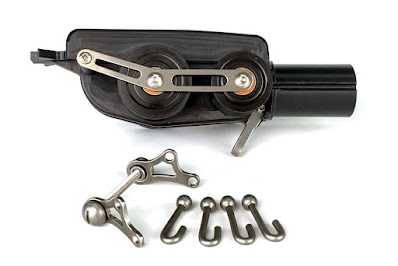
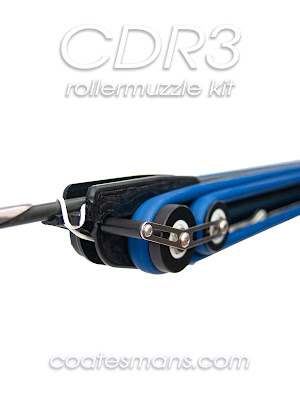
The NEW Coatesman CDR3 is specifically designed to fit on 26.5mm ID Rob Allen carbon speargun barrels. The double roller speargun muzzle enables the spearfisherman to easily load the twin 14mm bands, which deliver way more power than if you were loading a single 16mm or even 18mm band. The double bands produce a very smooth accurate shot with virtually no recoil.
The CDR is the original offset double roller, with the unique roller setup that enables the rubbers to align correctly. The design has evolved over the past 5 years making it the most technically advanced double roller on the market.
The CDR3 double roller speargun muzzle utilizes the proven White Lightening ceramic bearings ensuring maximum efficiency and durability, even in the toughest shore diving environments. The muzzle body is machined nylon which has a very high impact resistance, making the CDR3 muzzle extremely robust.
The CDR3 now includes the Easy Load Pretension Hooks for pretensioning rubbers, and integrated line guide.
Coatesman’s tried & tested double roller speargun muzzle is used by some of the best spearfisherman in the world. Taking down some incredible catches The CDR3 is the premium option for upgrading your Rob Allen Speargun.
Here is my quick and easy method of tying dyneema roolergun wishbones with handles. In this How to video, I cover what you need and how to tie up the bridles. These 'soft' handloaders are better than the big hard ones and can tuck away in the rubbers once loaded so they don't obscure your vision when aiming.
In this spearfishing episode I am going to be dispelling the myth that long rollerguns don't work. As well as why I love my 120 single roller and why I think it's the best rollergun to date made by Rob Allen.
You hear it all the time out on the internet that long rollers don't work
In theory there should be no reason they would not work.
One of the reasons small guns work so well, is that proportionately you load more into them. Let me explain. If you are able to load 50-60kg then your loading capacity is the same whether the gun is 90cm or 120cm long. So it is easier to load the right amount of energy into a smaller gun than a longer one.
All most everything is scalable and the only variable is what you are able to load. And if what you can load is enough, which it probably is. Then there is no reason why longer 120 & 130cm rollerguns won't work.
In fact the 120 single roller is my all time favourite rollerguns and what I believe to the one best bluewater/reef all rounders available on the market. If I was could only have one gun, this would be it. Making this the best off the shelf gun made at the Rob Allen Dive Factory.
In this video I am going to go over my favorite setups for the 110 single rollergun from Rob Allen as well as going over what I think we should be prioritizing when it comes to roller gun setups in general.
When setting up a speargun of anytype there are three main elements to consider and that is:
Accuracy
Handling
Power
Range
The most important of these elements is accuracy, for obvious reasons.
You can have all the power in the world, but if you can hit the spot its pointless. Accuracy is the golden key to any magic setup and has to be your first priority.
However most guys focus on ‘power & range’ when setting up their guns, and just assume that because it is a roller it will be accurate.
Another problem with having ‘power & range’ as your focus when setting up guns is not paying attention to how the gun handles in the water.
Recoil, weight & maneuverability all affect how the gun feels. This might seem insignificant to some, but how the gun handels affects accuracy. Recoil affects the guns accuracy, and the way the gun handles will affect your accuracy.
It is the way you and the gun interact. Heavy or cumbersome guns, hinder agility. Agility affects your reaction time.
The faster you can take advantage of a situation, the greater options and opportunities you have of a good shot.
When things are smooth and predictable, it is easy to be comfortable and find confidence in the gear.
Confidence is another key element to accuracy, this is the accuracy that you as a diver develop with experience, enabling those quick instinctive lethal shots.
So when you have accuracy as your starting point when deciding on a setup. You need to also prioritise how the gun feels and handles, over how much power and range it will have.
Work with in the power and range a good setup can give you. And not the other way round.
Using this philosophy on gun set ups lets take a look at the 110
Unrolling the Spearfishing Rollergun Series Part 2 is now up.
In this spearfishing workshop episode, I cover the difference between the standard preload and the full pretension preload on rollerguns.
Here is the newest version of the Coatesman Double Roller:
Speargun pool testing with MJK. 4 rubber Sea Sniper vs Alimanni 140 Bluewater Express roller gun (modified with ceramic bearings and my tried and tested rubber setup) Also tested some refined rubber setups on the Rob Allen / Power rollerhead roller gun. The customised Alemanni kicked ass. And settled any doubt which gun we are taking big game hunting. As always the Rob Allen roller conversations performed exceptionally well and the max powered 16mm rubbers with 7mm shaft is magic on the 1200.
After a few test variations here is a custom MAMBA 600 rollergun with Rob Allen mech Mamba barrel and Roller Powerhead. For a VIP client needing a super short rollergun for grouper in tight holes. Cool additions are the the slim line Rob Allen Vecta reel and new finger trapped 1000lb olive green dyneema ... Over kill I know :-)
My 35kg welcome home present with a 1100 Rollergun.
Over the last 4 months I have not blogged much, I took 3 months off spearfishing to do a Commercial dive ticket. But I am back and starting to get wet again, so you guys can stop sending me love/hate mail for not blogging :-)
Yesterday was my first dive here back home since May!! I took a drive up the coast to a spot I thought I might find a few fish to get back into the swing of things. The water looked ok from the beach and was a bit murky in the backline. It got ridiculously clean from about about 250m from shore.
Crystal clean water in winter is often not a good thing as it is often 'sterile' and not very fishy. On the reef the few fish that were around were not interested at all in coming home with me.
I decided to swim against the current to the front of the deepest ledge to see if there was anything congregating there. The plan was if there was nothing there then to head back inshore and catch some buggs.
As I got to the 20m drop there is a small finger that juts out into the strong south to north current. As I got to the spot I saw the Salmon from the surface. I have dived this ledge for 20 years and it always seemed like a good spot for Salmon but I had never seen them there before.
I turned into the current trying to hold my position over the ledge while breathing up. Flip it's harder than you think! My prep was terrible and I was breathing heavily from finning ... and possibly the excitement, but decided to dive sooner than later as I did not want them to spook and swim off.
By the time I got to the top of the ledge in 19m I was a few meters back from where the Salmon where sitting. I dropped my anchor and snuck up towards them. As I got to the ledge and I could see the one sitting on the sand I tried to keep really low and out of sight. This did not happen tho there were 3 fish and the 2 smaller ones saw me and light up as they started to move off.
S*#T! I am not going to get close enough. All I had was a 1100 Rob Allen roller gun with 16mm bands, the gun I use for reefies and small mackerel. I edged to about half a meter before the edge of the ledge and lined up. I was thinking I really need to be coming dow the ledge on this fish. While I was debating with myself what to do the fish sees me and starts to turn. Thwaack the decision was made and the spear hit the fish behind the head almost stoning it.
The fish slowly glided off into the current and I was unable to see if the spear had gone through at that distance. I bailed for the surface and was fortunate to be able to incept my float that was anchored on the ledge. I clipped of the gun and put the reel on free spool. I grabbed my 900 roller gun with 14mm bands and swam off after the fish following the dyneema reel line.
Eventually the fish slowed down but the current was pulling hard on the fish which pulled out all the reel line and had come to a solid stop. Deciding not to risk loosing the fish I did the long swim down after the fish and put in a securing shot with the 900 ... which when right though the fish.
It took about 20min to pull myself back to the float with the fish, which was now a whole lot bigger than I thought it first was. After sorting out a massive tangle of dyneema which had collected around one of the guns while pulling back up the current I head back inshore and got some buggs.
The swim back to shore was a killer and negotiating the shore break was fairly interesting. This however, was all was done with a decent dollop of satisfaction. I guess if there ever was away to have a 'welcome back' this is it.
Coatesman
P.S - if there ever was any doubt in my mind about the roller gun story this fish sorted that out.